Reading The Active City feels a bit like walking through a city you thought you already knew, only to notice—really notice—how its movement shapes you. The book doesn’t so much shout its thesis as it reveals it, piece by piece: cities are living systems, and our bodies are quietly negotiating their design every day.
What stands out isn’t just its call for “active design,” but its insistence that urban planning and human vitality are inseparable. It’s easy to think of parks, bike lanes, or shaded sidewalks as pleasant extras. But the book argues, sometimes gently and sometimes bluntly, that they’re the city’s pulse. And perhaps more provocatively, it suggests that inactivity—our default modern condition—isn’t just a health issue, but an urban design failure.
As I moved through its pages, I found myself thinking about Addis Ababa—its steep streets, its informal markets, the way people constantly improvise movement. There’s a vitality that no master plan can capture, though it can certainly be nurtured or, sadly, erased. The Active City may not have set out to describe cities like mine, but it inadvertently speaks to them. It reminds us that activity doesn’t always come from policy—it often grows from friction, from people negotiating uneven ground, both literally and metaphorically.
The book, published under the World Bank’s Global Platform for Sustainable Cities, reads partly as research, partly as advocacy. It’s packed with examples: Copenhagen’s bike infrastructure, New York’s High Line, Bogotá’s ciclovías. These are familiar icons in the literature of urban optimism. Yet what makes the argument persuasive is not the success stories themselves, but the framing—they aren’t imported solutions, but experiments in social choreography. Cities, the authors seem to suggest, are not machines to be tuned but rhythms to be listened to.
Still, I found myself hesitating at times. The emphasis on “design for activity” risks romanticizing motion itself, as if all movement were inherently good. But not all activity signals vitality. The frantic dash across unsafe intersections, the long walks caused by inadequate transport, the carrying of water or goods for lack of infrastructure—these, too, are forms of movement, but born from absence, not agency. The book occasionally brushes past that nuance, though it gestures toward equity as a goal. A truly “active” city, one might argue, is not merely kinetic—it’s enabling.
Where the book succeeds most is in its quiet humanism. It recognizes that design can coax, but not command, behavior. A shaded bench may invite rest, a well-lit path may extend one’s evening stroll, but what ultimately sustains activity is culture—the small rituals of walking together, pausing to talk, playing, sharing space. The idea of the “active city” therefore feels less like a blueprint and more like a philosophy: to design for possibility rather than prescription.
I was especially drawn to its discussion of public health, not as a siloed discipline but as an urban narrative. The authors trace how car-centric planning, privatized recreation, and sedentary office life gradually hollowed out the physicality of daily existence. What once came naturally—walking to school, running errands, even standing in line—has been engineered out of habit. And so the city, they argue, must reintroduce movement as a civic right. There’s something compellingly moral about that stance: that streets, parks, and plazas are not amenities, but public health infrastructure.
Reading this, I kept returning to Addis again—the way Meskel Square transforms during holidays, or how informal sports fields materialize in empty lots. None of these are designed as “active spaces” in the Western sense, yet they achieve exactly what the book celebrates: spontaneous, collective energy. It makes me wonder if “active design” is less a new discipline and more a rediscovery of what many cities—especially in Africa—never entirely lost: the social fabric of shared movement.
But the book’s optimism also feels, at times, quietly haunted. Its case studies come from cities with resources and governance structures capable of sustaining long-term design interventions. For places where informality, inequality, and infrastructure deficits dominate, the lessons may feel aspirational. That’s not a flaw of the argument, exactly—more a reminder of its context. The challenge for many of us reading from the Global South is how to translate this philosophy into cities where walking is not a lifestyle choice but an economic necessity.
And yet, perhaps that’s precisely why the idea of the active city matters. It’s a vision that reclaims the public realm from the car, from private capital, from the inertia of poor planning. It says: movement is belonging. It’s not a grand solution, but a quiet provocation.
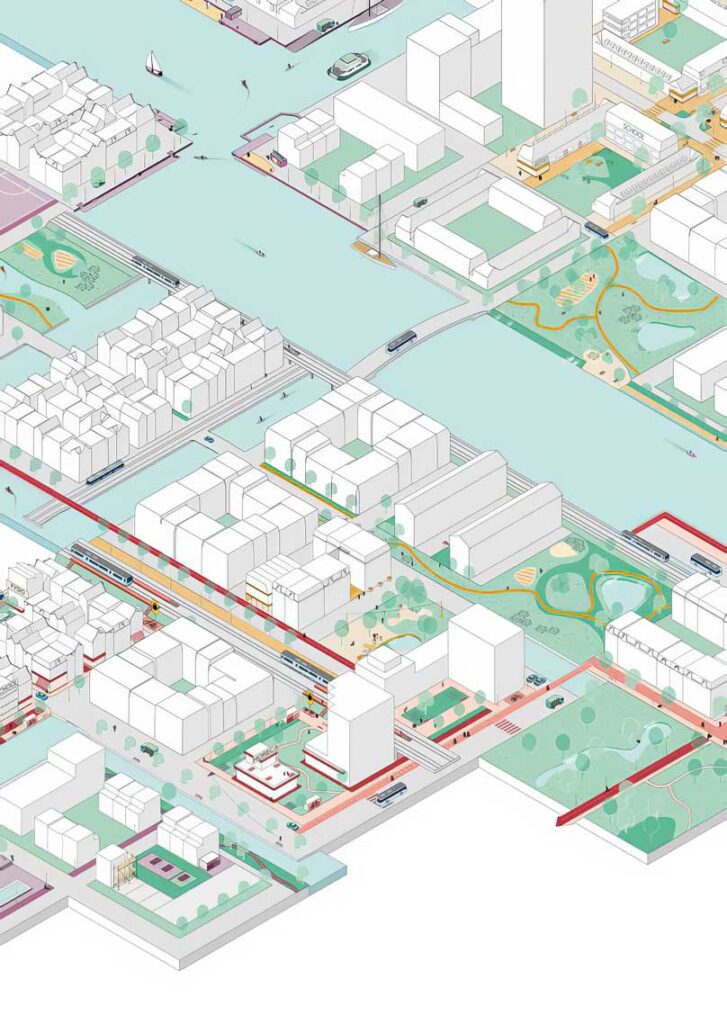
What lingers after finishing The Active City is not its diagrams or statistics, but its invitation—to see design as a kind of empathy in motion. Cities, the authors remind us, are not passive backdrops. They react. They respond. They invite or exclude, empower or exhaust. A step, a pause, a conversation under a tree—all are evidence that space matters.
If anything, the book may be most valuable not as a manual but as a mirror. It makes you look differently at the streets you walk every day. It asks, without saying it outright: does your city let you move freely, or does it hold you still?
And maybe that’s the question worth carrying—not as planners or architects, but as citizens.