UN-Habitat’s Catalogue of Solutions 2026–2029 argues that the future of urban life will depend less on grand masterplans and more on practical, adaptable systems rooted in equity, resilience, and local participation.
Published by the United Nations Human Settlements Programme, the Catalogue of Solutions 2026–2029 is less a conventional policy document than a global operating manual for the urban century. Across more than 100 pages, the publication assembles 81 tested tools, frameworks, and implementation strategies aimed at helping governments, planners, and development agencies confront some of the defining pressures shaping contemporary cities: housing shortages, informal urbanization, climate vulnerability, displacement, failing infrastructure, and widening inequality.
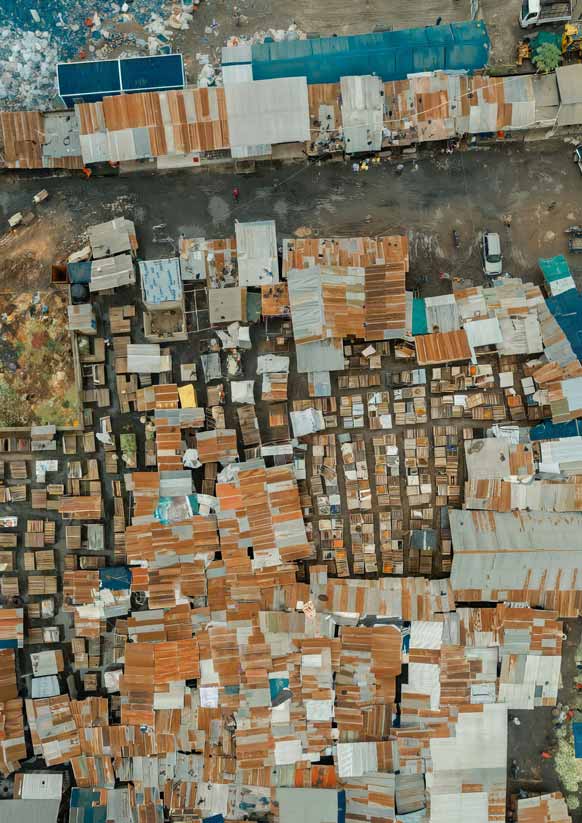
The scale of the challenge is laid out early and without much optimism. Around 1.1 billion people currently live in slums or informal settlements globally, while another two billion are expected to face similar conditions over the next three decades if current trajectories continue. Housing, the report insists, is no longer simply a social issue or a real-estate concern—it has become the central infrastructure of economic stability, climate resilience, health, and social cohesion.
Rather than offering visionary rhetoric alone, the catalogue is structured around actionable systems. Organized into three broad sections—strategic focus areas, impact areas, and implementation mechanisms—the document maps how urban challenges intersect with land governance, infrastructure, finance, planning, participation, and data systems.
One of the publication’s more compelling qualities is its refusal to treat urbanization as a singular problem with universal solutions. Instead, it emphasizes adaptable methodologies tested across very different contexts—from post-conflict Iraq and Syria to informal settlements in Nairobi, climate-vulnerable coastal regions, and rapidly expanding metropolitan areas in Latin America and Asia. The result is a catalogue that reads partly like a toolkit and partly like a record of institutional learning.
Housing and land governance form the backbone of the report. Several featured solutions focus on securing land tenure, preventing forced evictions, and improving access to affordable housing through participatory and data-driven approaches. In particular, the Social Tenure Domain Model (STDM)—a low-cost, open-source land information system—emerges as one of the report’s recurring instruments. Designed to map and document land relationships even in informal or legally ambiguous contexts, the system has already been deployed in countries including Zambia, Nepal, Iraq, Uganda, and the Democratic Republic of Congo.
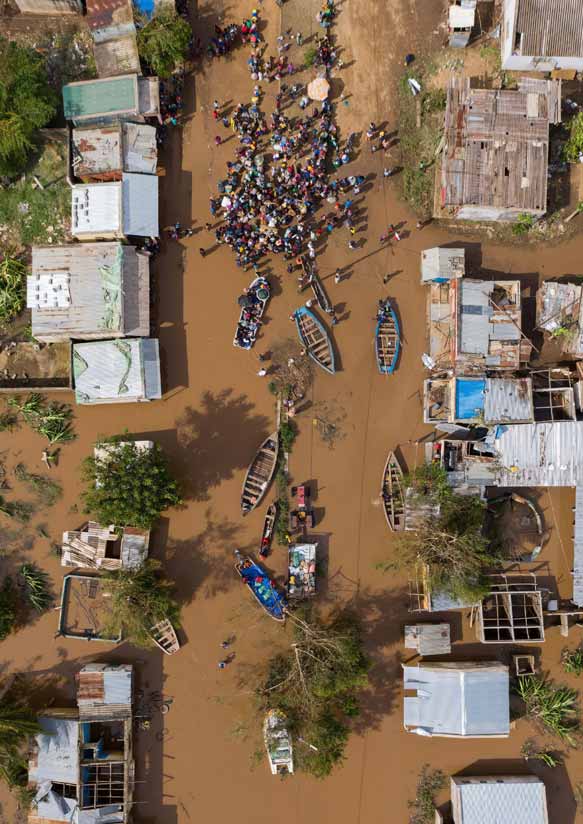
The catalogue also pays significant attention to informal settlements, though notably with less emphasis on demolition and replacement than on incremental upgrading. Community mapping, in-situ upgrading, and participatory planning are repeatedly positioned as alternatives to top-down redevelopment models that often displace vulnerable residents. That shift reflects a broader evolution in international urban policy over the past two decades: from viewing informal settlements as urban failures to recognizing them as complex social and economic systems requiring integration rather than erasure.
Climate adaptation appears throughout the publication not as a standalone environmental issue but as an urban management challenge embedded in land use, infrastructure, mobility, and public space. Solutions range from sustainable transport planning and energy-efficient buildings to ecological asset protection and territorial climate-risk diagnostics. What becomes clear is that resilience, in UN-Habitat’s framing, is increasingly inseparable from governance capacity.
There is also a noticeable emphasis on participation. Initiatives such as Block-by-Block, Her City Toolbox, and youth-focused urban resource centers suggest a growing institutional recognition that urban planning can no longer operate solely through centralized expertise. Whether these participatory models meaningfully redistribute power is perhaps still open to debate, but the report argues strongly for co-creation as both a planning method and a social process.
At times, the catalogue’s bureaucratic language and extensive use of development terminology can feel dense. Acronyms accumulate quickly, and the publication occasionally leans heavily on institutional frameworks and indicators. Yet beneath that technical structure lies a surprisingly coherent argument: cities cannot solve housing, inequality, or climate vulnerability in isolation. Urban systems are interconnected, and interventions must operate across governance, finance, infrastructure, ecology, and community life simultaneously.
For architects and urban practitioners, the publication offers an interesting shift in perspective. Buildings alone are largely absent from the conversation. Instead, architecture is positioned within wider systems of land, infrastructure, social policy, and environmental management. The emphasis is less on iconic projects and more on long-term urban capacity.
In that sense, the Catalogue of Solutions 2026–2029 reflects a broader transformation in how global institutions now imagine urban futures. The question is no longer simply how to build more cities, but how to make rapidly expanding urban environments more equitable, resilient, and governable under increasingly unstable conditions.
Whether these solutions can move from pilot frameworks into meaningful large-scale implementation remains uncertain. Still, the document offers a useful snapshot of where international urban thinking currently stands: pragmatic, data-driven, deeply concerned with inequality, and increasingly aware that the future of cities may depend as much on social systems as on physical form.