Cities are often remembered through their landmarks, but they are understood through the buildings that quietly accompany everyday life. Addis Ababa is no exception. Its modernist apartments, civic buildings, villas, cinemas, and commercial blocks have long shaped the city’s identity, yet many now stand at a crossroads transformed, neglected, or disappearing altogether beneath the pressure of rapid urban development.
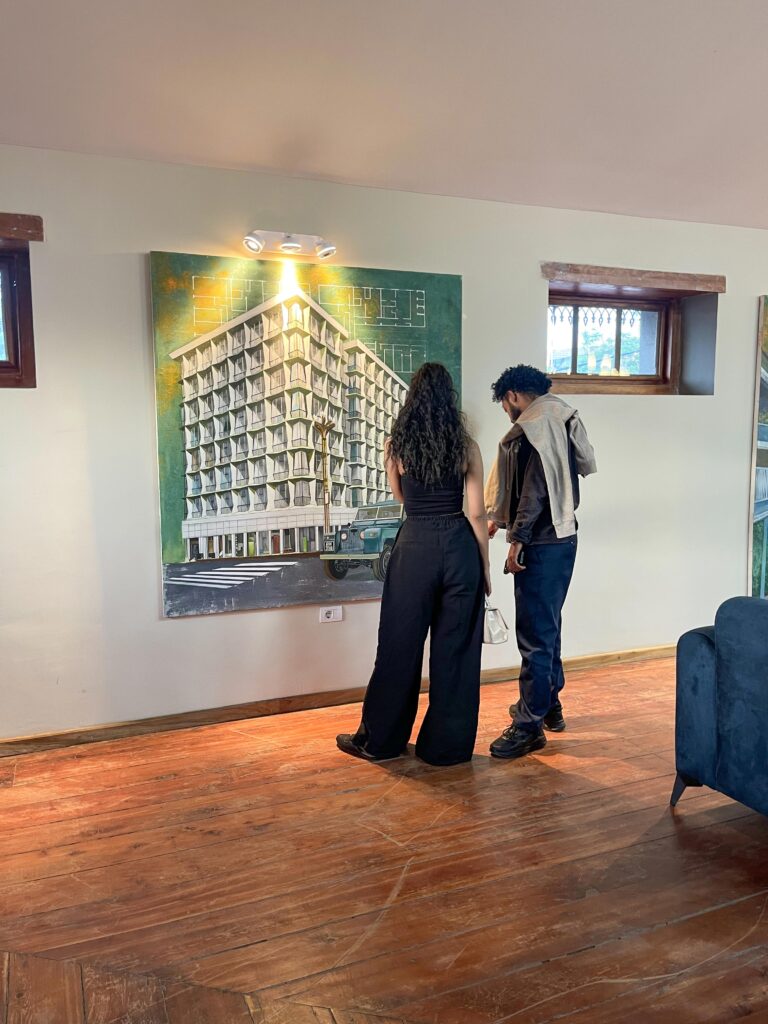
Addis Modern, a recent exhibition by architect and visual artist Yohannes Girma, invites visitors to reconsider these familiar structures not simply as buildings, but as repositories of memory. Rather than documenting architecture with technical precision, the exhibition explores the emotional and cultural life embedded within Addis Ababa’s built environment.
For an architect, painting may seem an unexpected medium. Yet perhaps it allows a different kind of observation. Architectural drawings often seek accuracy; paintings allow atmosphere, memory, and interpretation to emerge. Yohannes’s work occupies this intersection. His canvases examine buildings through the lens of space, proportion, light, and urban context, while acknowledging that every structure carries both visible and invisible traces of the people who have occupied it over time.
The exhibition shifts the conversation away from architecture as isolated objects. Instead, it presents Addis Ababa itself as a layered archive; a city where buildings accumulate stories through decades of use, adaptation, and collective experience. Familiar facades become witnesses to changing neighborhoods, evolving communities, and shifting cultural identities. What emerges is not simply a catalogue of architecture, but a portrait of urban memory.
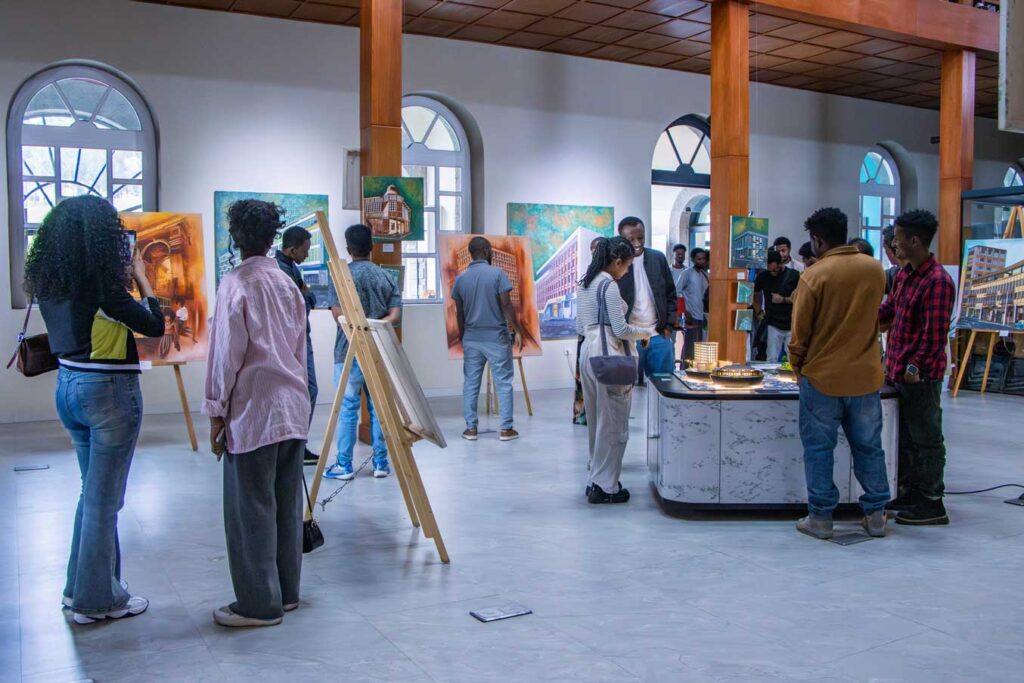
One of the exhibition’s most compelling devices is the repetition of the same architectural subjects in two distinct color palettes: red and green. This is far more than an aesthetic choice. Red evokes urgency, memory, and the fragility of heritage, while green suggests endurance, continuity, and the possibility of renewal. By presenting identical forms through different chromatic lenses, the artist encourages viewers to question how perception changes while the physical architecture remains constant.
The result is surprisingly reflective. A single building can feel vulnerable in one painting and hopeful in another, reminding us that architecture is never experienced independently of the cultural and emotional frameworks through which we encounter it.
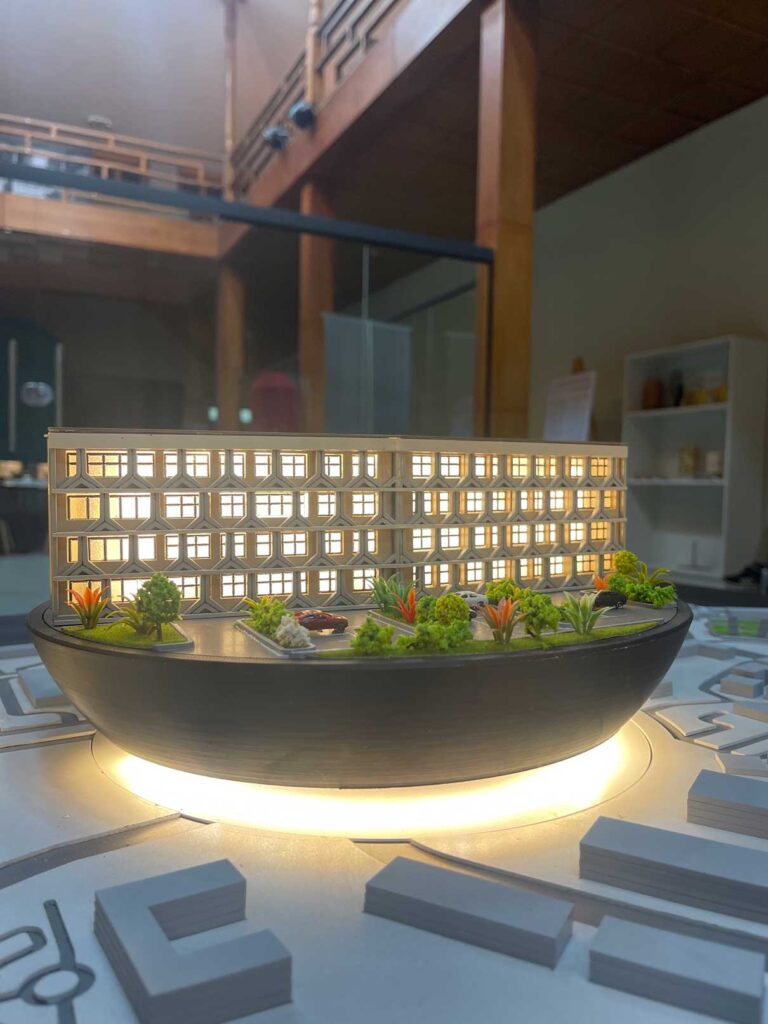
This approach also raises broader questions about conservation. Much of Addis Ababa’s twentieth-century architecture occupies an uncertain position. Too recent to be universally celebrated as heritage, yet too significant to disappear unnoticed, these buildings often fall into a gap between development and preservation. The exhibition does not argue against change. Rather, it asks whether progress must come at the expense of memory.
That question feels particularly relevant today. Addis Ababa continues to transform at an extraordinary pace. Roads expand, neighborhoods densify, and new skylines emerge almost yearly. Amid this momentum, exhibitions like Addis Modern offer an opportunity to pause not out of nostalgia, but out of curiosity. What do we choose to remember? Which buildings continue to shape our collective identity, even after their original functions have changed?
Perhaps the greatest strength of the exhibition lies in its refusal to romanticize the past. These paintings are neither preservation documents nor sentimental recollections. They acknowledge that cities evolve, but they also suggest that memory should evolve alongside them. Buildings become cultural records whose meanings are constantly rewritten by new generations.
In many ways, Addis Modern sits at the intersection of architecture, art, and urban history. It demonstrates that painting can become another form of architectural discourse, one capable of revealing relationships between people and place that conventional documentation may overlook. Through observation and interpretation, the exhibition maps not only what is visible, but also what is remembered.
For architects, artists, historians, and anyone who calls Addis Ababa home, the exhibition offers something increasingly valuable: a reminder that cities are not built only with concrete and steel. They are also built through memory. And sometimes, the most meaningful way to preserve architecture is not simply to restore its walls, but to keep its stories alive.